Hidden deep within Jordan’s desert canyons, Petra is an architectural wonder that tells the story of a lost civilization’s brilliance. Built over 2,000 years ago by the Nabataeans, this once-thriving city was a powerful trade hub linking Arabia, Egypt, and the Mediterranean. Known as the “Rose City” for its stunning pink-hued rock formations, Petra flourished through its mastery of water conservation, with an advanced system of dams, cisterns, and channels that sustained its people in the harsh desert climate.
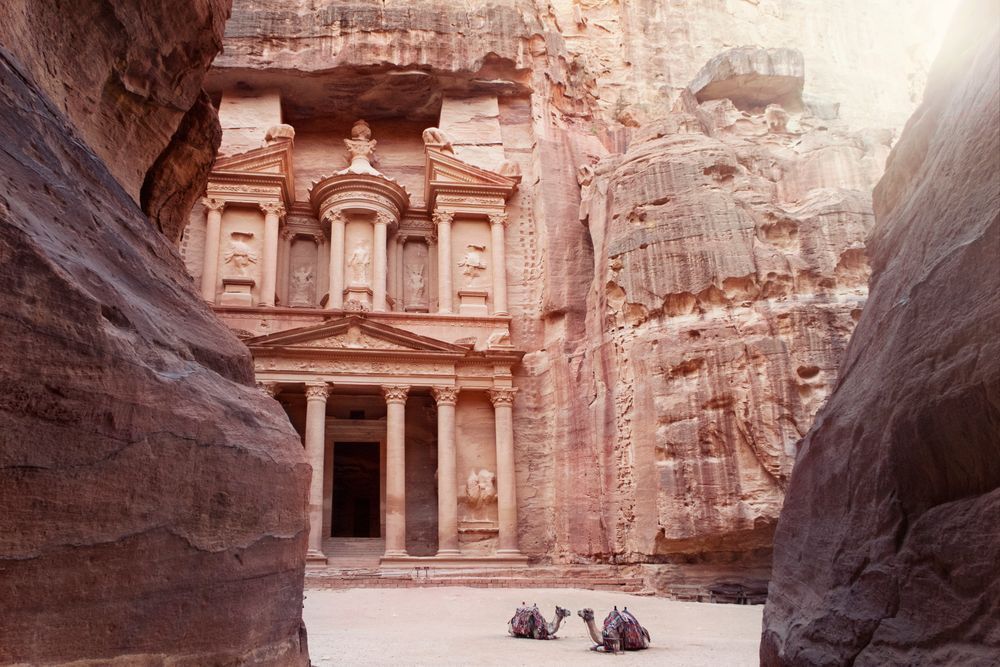
The image showcases Al-Khazneh (The Treasury), Petra’s most famous monument, carved directly into the sandstone cliffs. Though its true purpose remains debated—some believe it was a royal tomb, while others suggest it served as a temple—its grandeur reflects the city’s prosperity during the 1st century BCE. Beyond the Treasury, Petra extends into a labyrinth of tombs, temples, and even an amphitheater, all carved into the rugged mountainsides.
Abandoned after devastating earthquakes and shifting trade routes, Petra remained forgotten by the Western world until Swiss explorer Johann Ludwig Burckhardt rediscovered it in 1812. Today, it stands as a UNESCO World Heritage Site and one of the New Seven Wonders of the World, offering a glimpse into the ingenuity and legacy of the Nabataeans. In the foreground, camels rest beneath the towering cliffs—silent witnesses to the passage of time, just as traders and travelers once paused here on their journey through this extraordinary desert city.